

D2D China: Are the GPU Sanctions Working?
A look at how PRC companies are coping without access to Nvidia
In which we explore the ways in which PRC AI companies are making the best of constraints, examine the shifting situation for the semiconductor industry’s access to capital, and more.
We will be in Taipei, Beijing, Shenzhen, Shanghai and possibly other cities in early June. If you would like to meet, or want to suggest some companies we whould meet, send us an email.
我们将于六月上旬走访台北、北京、深圳、上海,也可能前往其他城市。如您有意会面,或可为我们引荐一些值得拜访的公司,欢迎随时来邮联系。
Noteworthy Items
Semis and Deep Tech
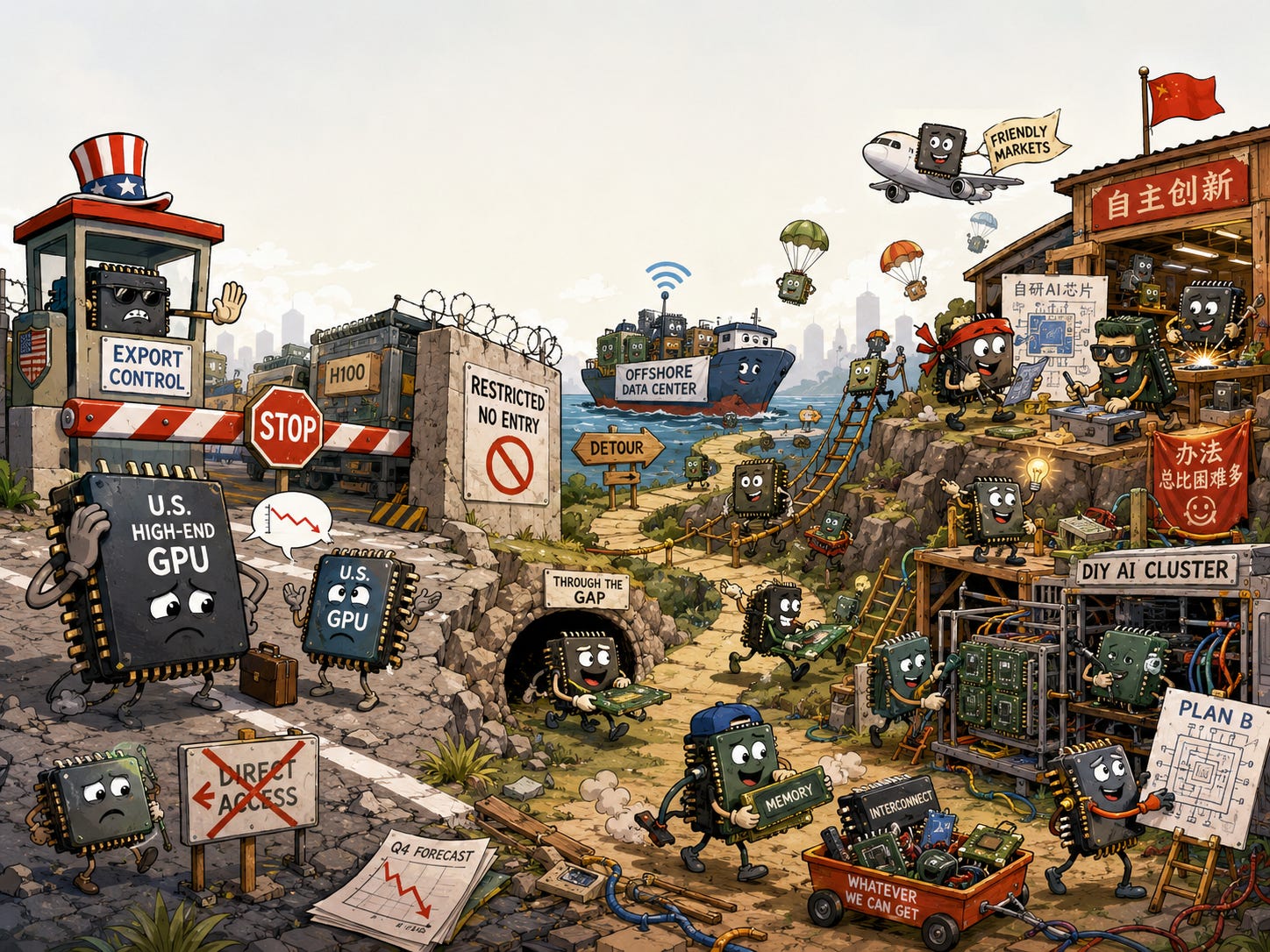
Nvidia’s CEO has recently been very vocal that Nvidia’s share has gone from 90% to 50% since the US blocked its shipments of essentially all GPUs to the PRC. The official view on the ground there is that this is an incredible boon to Nvidia’s domestic competitors. We think the reality is much more complicated, and is the topic of our essay below.
For decades Microsoft has certified CPUs and GPUs as ‘compliant’ with Windows requirements. It has just certified its first PRC GPUs. These are desktop parts, not really intended for AI data centers, but the implication and validation is pretty clear.
A big trend this year is the domesticization of the PRC wafer fabrication equipment (WFE) industry. This has been going on for years, but there seems to be a real surge with some reports saying PRC fabs now purchase 30% of their tools from PRC suppliers, a big jump from the low teens a year ago. On top of that, the industry is spending incredibly heavily.
We found this profile of Cornerstone Capital (基石资本). Cornerstone has emerged as…well.. a cornerstone of PRC semis investments. They have stakes in Changxin Memory, YMTC Memory, Biren, and many other now high-flying companies. Lots to read in here about the semis industry, its surrounding ecosystem and AI, and the ways in which all of those have changed in recent years.
Optics and glass substrates are hot topics in semiconductors globally, and these PRC companies are carving out a stake in the market. We will watch this area, this feels like a field where PRC companies could leapfrog US companies.
On a similar theme, this is a profile of NSN, a semis testing company. We thought their trajectory from the very bottom of the market to a highly competitive player provides a good case study in the dynamic underway for many PRC companies today.
A view from the PRC on the global memory shortage. Key paragraph below. We had fun parsing this one - Beijing would very much like its domestic memory makers to add capacity, move up the technical ladder and start competing with foreign vendors, not each other.
The Ministry of Industry and Information Technology made clear on April 21 that it will support the memory industry in two aspects: first, enhance the supply capacity, encourage domestic and foreign enterprises to increase investment, enhance output, and support end enterprises to strengthen synergy with memory enterprises and diversify supply channels. The second is to maintain market order, guide enterprises to strengthen channel management, and cooperate with relevant departments to combat disruptive actions in accordance with the law.”
The PRC take on Intel/SpaceX’s Terafab is highly skeptical. No one really knows what Elon is planning for Terafab. So the main takeaway from this article should be the PRC is watching Elon closely and weighing its options.
Semis and Capital
Something has shifted in the PRC capital markets. Companies are starting to raise venture capital again after a long pause. There is also a growing number of semis IPOs hitting the market. Signs of thawing in the capital markets, implying the past few years of the government “re-directing” the flow of capital has finished. That being said, see if you can spot a pattern in what types of companies are getting funded.
Recent IPOs:
Suzhao Huatai makes analog parts for various wireless markets.
Super Fusion designs servers and data centers systems. Noteworthy in that it is a Huawei spin-off.
The best performing stock to IPO this year is Lianxun Instrument which makes test and measurement equipment for semis.
The biggest IPO in the PRC this year is Shenghe Jingwei a semiconductor packaging company. The company now has a USD$36 billion market cap, up almost 70% since the April listing. Another PRC WFE success story. But also, worth noting this is essentially foundry SMIC’s packaging line, spun off into a joint venture with a smaller OSAT company, so there is a geo-political angle with SMIC on the US entity list.
Recently public GPU maker Moore Threads had a solid first earnings report after its IPO.
We are starting to see fund raising activity pick up for PRC start-ups again. These went from one day three years ago to virtually zero last year. Yixing Intelligence just raised RMB 1.5 billion to build a RISC V chip, an AI accelerator of course.
Software
PRC automotive software companies appear to be doing very well. PRC electric vehicles (EVs) compete heavily on their user interface and we are seeing many companies emerge to serve these software needs. Many of them are spin-offs from the EV companies themselves, but it is clear a new industry is emerging. And these companies are starting to export their software. We may not see PRC EVs in the US, but we may see this software.
Automotive, Industrial and Macro-Economic
The common story in US and European media (and to some degree here) holds that the PRC has too much industrial capacity and is exporting its way out of an economic downturn. This has led to a flood of manufactured products ‘flooding’ global markets - EVs, solar panels and industrial tool. This author examines that analysis from a PRC perspective by looking at the German industrial tools market. Their analysis says that German tool companies, once a central pillar of the German economy, has fallen on hard times for several reasons. Imports from the PRC are part of the problem, but they also point out several internal reasons - regulation and underinvestment, etc.
If you like this content, you should listen to this podcast.

For paid subscribers, our deep dive into the impact of US restrictions on sales of GPUs to the PRC. Are they working? Sortof. Maybe. Possibly not.
